
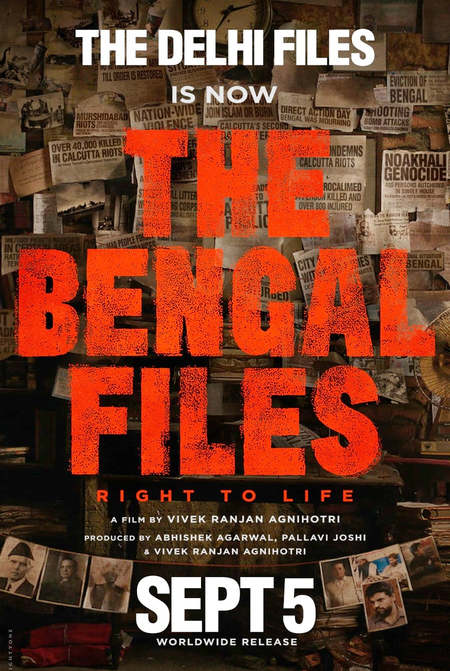
The Bengal Files
A Visceral Journey Through History’s Darkest Chapters
Plot Overview
The Bengal Files serves as the explosive final installment in Vivek Agnihotri’s controversial Files trilogy. The narrative masterfully weaves together dual timelines, connecting the horrific 1946 Great Calcutta Killings and Noakhali riots with present-day West Bengal.
The contemporary storyline follows CBI officer Shiva Pandit (Darshan Kumar), a Kashmiri Pandit investigating the mysterious disappearance of Dalit journalist Gita Mandal in Murshidabad. His investigation leads to the powerful local MLA Sardar Husseini (Saswata Chatterjee), but political pressure and lack of evidence create a web of corruption and cover-ups.
Through haunting encounters with elderly Bharati Banerjee/Maa Bharati (Pallavi Joshi), who suffers from dementia but retains vivid memories of Partition violence, the film transitions to 1946 Bengal, depicting the horrors of Direct Action Day on August 16, 1946.
Outstanding Performances
Pallavi Joshi delivers the film’s most compelling performance in a challenging dual role. Critics universally praise her emotional range and ability to carry the film’s heavy thematic weight, with her portrayal described as “brilliant” and “heart-wrenching.”
Mithun Chakraborty as Chatur provides one of his most impressive recent performances, embodying institutional failure and trauma as a former police officer turned alcoholic victim of the corrupt system.
Direction & Technical Aspects
Agnihotri’s direction maintains his trademark uncompromising approach to controversial historical subjects. However, the film suffers significantly from its excessive 204-minute runtime, with critics describing it as “punishing” and “excruciatingly long.”
The cinematography presents violence with disturbing graphic detail, including scenes that critics describe as “nauseating” and “disturbingly graphic.” While this serves the director’s intent to shock audiences into confronting historical realities, many question whether such explicit imagery enhances the storytelling.
Production values reflect substantial research, with the team studying period newspapers, magazines, and firsthand accounts, though several historical inaccuracies and plot inconsistencies undermine the film’s credibility.
Critical Reception & Controversies
The film has generated polarized reactions, mirroring the controversy surrounding Agnihotri’s previous works. Supporters praise it as “gut-wrenching,” “hard-hitting,” and essential viewing for understanding suppressed historical truths, with some calling it a “masterpiece” while others dismiss it as “propaganda.”
Histrionic performances: Most actors resort to over-the-top theatrical delivery
One-dimensional portrayal: Lacks nuanced characterization of complex historical events
Poor narrative structure: Despite research, writing lacks sophistication for such complex material
Political Controversy has overshadowed the film’s release, with allegations of unofficial bans in West Bengal. Director Agnihotri and producer Pallavi Joshi claim theatre owners received threats from political party workers, leading to widespread screening cancellations.
Box Office & Historical Context
Despite controversy, The Bengal Files achieved better advance booking numbers than The Kashmir Files, collecting ₹1.22 crores in pre-sales. The film addresses the 1946 Direct Action Day and subsequent communal violence, though critics note the presentation often prioritizes emotional manipulation over historical accuracy.
While the historical events depicted were indeed tragic and significant, the film’s approach lacks the nuanced treatment such sensitive material requires, representing a missed opportunity to meaningfully explore important historical events through cinema.
About the Author